Bio::EnsEMBL::Hive::Process Class Reference
 Inheritance diagram for Bio::EnsEMBL::Hive::Process: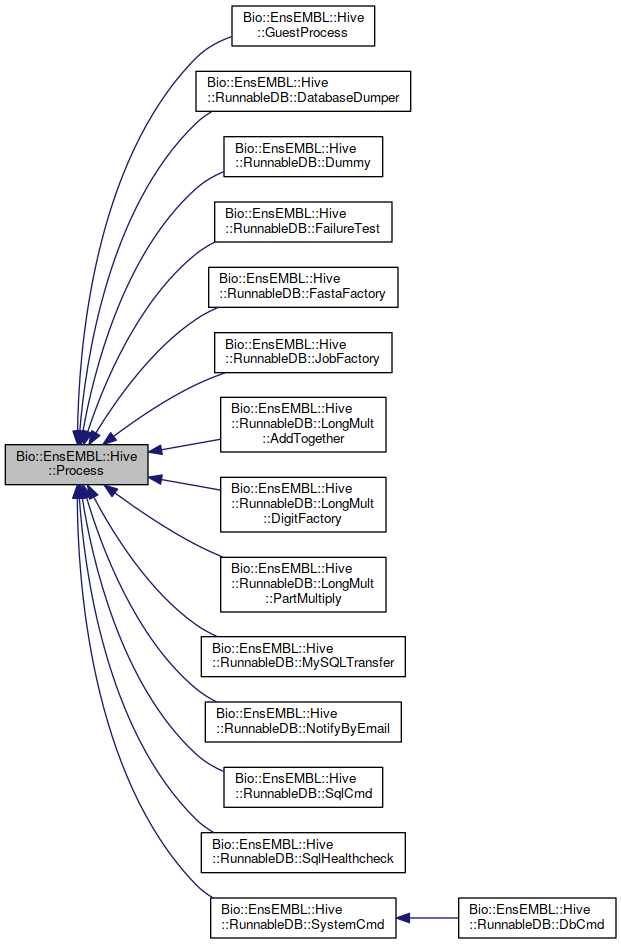
Public Member Functions | |
| public | new () |
| public | life_cycle () |
| public | say_with_header () |
| public | enter_status () |
| public | warning () |
| public | param_defaults () |
| public | fetch_input () |
| public | run () |
| public | write_output () |
| public Bio::EnsEMBL::Hive::Worker | worker () |
| public Boolean | execute_writes () |
| public Bio::EnsEMBL::Hive::DBSQL::DBAdaptor | db () |
| public Bio::EnsEMBL::Hive::DBSQL::DBConnection | dbc () |
| public Bio::EnsEMBL::Hive::DBSQL::DBConnection | data_dbc () |
| public Bio::EnsEMBL::Hive::AnalysisJob | input_job () |
| public | input_id () |
| public | param () |
| public | param_required () |
| public | param_is_defined () |
| public | param_substitute () |
| public | dataflow_output_id () |
| public | throw () |
| public | complete_early () |
| public Int | debug () |
| public | worker_temp_directory () |
| public | worker_temp_directory_name () |
| public | cleanup_worker_temp_directory () |
Detailed Description
Description
    Abstract superclass.  Each Process makes up the individual building blocks
    of the system.  Instances of these processes are created in a hive workflow
    graph of Analysis entries that are linked together with dataflow and
    AnalysisCtrl rules.

    Instances of these Processes are created by the system as work is done.
    The newly created Process will have preset $self->db, $self->dbc, $self->input_id
    and several other variables.
    From this input and configuration data, each Process can then proceed to
    do something.  The flow of execution within a Process is:
        pre_cleanup() if($retry_count>0);   # clean up databases/filesystem before subsequent attempts
        fetch_input();                      # fetch the data from databases/filesystems
        run();                              # perform the main computation
        write_output();                     # record the results in databases/filesystems
        post_cleanup();                     # destroy all non-trivial data structures after the job is done
    The developer can implement their own versions of
    pre_cleanup, fetch_input, run, write_output, and post_cleanup to do what they need.

    The entire system is based around the concept of a workflow graph which
    can split and loop back on itself.  This is accomplished by dataflow
    rules (similar to Unix pipes) that connect one Process (or analysis) to others.
    Where a Unix command line program can send output on STDOUT STDERR pipes,
    a hive Process has access to unlimited pipes referenced by numerical
    branch_codes. This is accomplished within the Process via
    $self->dataflow_output_id(...);

    The design philosophy is that each Process does its work and creates output,
    but it doesn't worry about where the input came from, or where its output
    goes. If the system has dataflow pipes connected, then the output jobs
    have purpose, if not - the output work is thrown away.  The workflow graph
    'controls' the behaviour of the system, not the processes.  The processes just
    need to do their job.  The design of the workflow graph is based on the knowledge
    of what each Process does so that the graph can be correctly constructed.
    The workflow graph can be constructed a priori or can be constructed and
    modified by intelligent Processes as the system runs.


    The Hive is based on AI concepts and modeled on the social structure and
    behaviour of a honey bee hive. So where a worker honey bee's purpose is
    (go find pollen, bring back to hive, drop off pollen, repeat), an ensembl-hive
    worker's purpose is (find a job, create a Process for that job, run it,
    drop off output job(s), repeat).  While most workflow systems are based
    on 'smart' central controllers and external control of 'dumb' processes,
    the Hive is based on 'dumb' workflow graphs and job kiosk, and 'smart' workers
    (autonomous agents) who are self configuring and figure out for themselves what
    needs to be done, and then do it.  The workers are based around a set of
    emergent behaviour rules which allow a predictible system behaviour to emerge
    from what otherwise might appear at first glance to be a chaotic system. There
    is an inherent asynchronous disconnect between one worker and the next.
    Work (or jobs) are simply 'posted' on a blackboard or kiosk within the hive
    database where other workers can find them.
    The emergent behaviour rules of a worker are:
    1) If a job is posted, someone needs to do it.
    2) Don't grab something that someone else is working on
    3) Don't grab more than you can handle
    4) If you grab a job, it needs to be finished correctly
    5) Keep busy doing work
    6) If you fail, do the best you can to report back

    For further reading on the AI principles employed in this design see:
        http://en.wikipedia.org/wiki/Autonomous_Agent
        http://en.wikipedia.org/wiki/Emergence
Member Function Documentation
◆ cleanup_worker_temp_directory()
| public Bio::EnsEMBL::Hive::Process::cleanup_worker_temp_directory | ( | ) |
    Title   :  cleanup_worker_temp_directory
    Function:  Cleans up the directory on the local /tmp disk that is used for the
               worker. It can be used to remove files left there by previous jobs.
    Usage   :  $self->cleanup_worker_temp_directory;
Code:
click to view
◆ complete_early()
| public Bio::EnsEMBL::Hive::Process::complete_early | ( | ) |
Undocumented method
Code:
click to view
◆ data_dbc()
| public Bio::EnsEMBL::Hive::DBSQL::DBConnection Bio::EnsEMBL::Hive::Process::data_dbc | ( | ) |
    Title   :   data_dbc
    Usage   :   my $data_dbc = $self->data_dbc;
    Function:   returns a Bio::EnsEMBL::Hive::DBSQL::DBConnection object (the "current" one by default, but can be set up otherwise)
    Returns :   Bio::EnsEMBL::Hive::DBSQL::DBConnection
Code:
click to view
◆ dataflow_output_id()
| public Bio::EnsEMBL::Hive::Process::dataflow_output_id | ( | ) |
Undocumented method
Code:
click to view
◆ db()
| public Bio::EnsEMBL::Hive::DBSQL::DBAdaptor Bio::EnsEMBL::Hive::Process::db | ( | ) |
    Title   :   db
    Usage   :   my $hiveDBA = $self->db;
    Function:   returns DBAdaptor to Hive database
    Returns :   Bio::EnsEMBL::Hive::DBSQL::DBAdaptor
Code:
click to view
◆ dbc()
| public Bio::EnsEMBL::Hive::DBSQL::DBConnection Bio::EnsEMBL::Hive::Process::dbc | ( | ) |
    Title   :   dbc
    Usage   :   my $hiveDBConnection = $self->dbc;
    Function:   returns DBConnection to Hive database
    Returns :   Bio::EnsEMBL::Hive::DBSQL::DBConnection
Code:
click to view
◆ debug()
| public Int Bio::EnsEMBL::Hive::Process::debug | ( | ) |
    Title   :  debug
    Function:  Gets/sets flag for debug level. Set through Worker/runWorker.pl
               Subclasses should treat as a read_only variable.
    Returns :  integer
Code:
click to view
◆ enter_status()
| public Bio::EnsEMBL::Hive::Process::enter_status | ( | ) |
Undocumented method
Code:
click to view
◆ execute_writes()
| public Boolean Bio::EnsEMBL::Hive::Process::execute_writes | ( | ) |
    Title   :   execute_writes
    Usage   :   $self->execute_writes( 1 );
    Function:   getter/setter for whether we want the 'write_output' method to be run
    Returns :   boolean
Code:
click to view
◆ fetch_input()
| public Bio::EnsEMBL::Hive::Process::fetch_input | ( | ) |
    Title   :  fetch_input
    Function:  sublcass can implement functions related to data fetching.
               Typical acivities would be to parse $self->input_id .
               Subclasses may also want to fetch data from databases
               or from files within this function.
Code:
click to view
◆ input_id()
| public Bio::EnsEMBL::Hive::Process::input_id | ( | ) |
Undocumented method
Code:
click to view
◆ input_job()
| public Bio::EnsEMBL::Hive::AnalysisJob Bio::EnsEMBL::Hive::Process::input_job | ( | ) |
    Title   :  input_job
    Function:  Returns the AnalysisJob to be run by this process
               Subclasses should treat this as a read_only object.
    Returns :  Bio::EnsEMBL::Hive::AnalysisJob object
Code:
click to view
◆ life_cycle()
| public Bio::EnsEMBL::Hive::Process::life_cycle | ( | ) |
Undocumented method
Code:
click to view
◆ new()
| public Bio::EnsEMBL::Hive::Process::new | ( | ) |
Undocumented method
Code:
click to view
◆ param()
| public Bio::EnsEMBL::Hive::Process::param | ( | ) |
Undocumented method
Code:
click to view
◆ param_defaults()
| public Bio::EnsEMBL::Hive::Process::param_defaults | ( | ) |
    Title   :  param_defaults
    Function:  sublcass can define defaults for all params used by the RunnableDB/Process
Code:
click to view
◆ param_is_defined()
| public Bio::EnsEMBL::Hive::Process::param_is_defined | ( | ) |
Undocumented method
Code:
click to view
◆ param_required()
| public Bio::EnsEMBL::Hive::Process::param_required | ( | ) |
Undocumented method
Code:
click to view
◆ param_substitute()
| public Bio::EnsEMBL::Hive::Process::param_substitute | ( | ) |
Undocumented method
Code:
click to view
◆ run()
| public Bio::EnsEMBL::Hive::Process::run | ( | ) |
    Title   :  run
    Function:  sublcass can implement functions related to process execution.
               Typical activities include running external programs or running
               algorithms by calling perl methods.  Process may also choose to
               parse results into memory if an external program was used.
Code:
click to view
◆ say_with_header()
| public Bio::EnsEMBL::Hive::Process::say_with_header | ( | ) |
Undocumented method
Code:
click to view
◆ throw()
| public Bio::EnsEMBL::Hive::Process::throw | ( | ) |
Undocumented method
Code:
click to view
◆ warning()
| public Bio::EnsEMBL::Hive::Process::warning | ( | ) |
Undocumented method
Code:
click to view
◆ worker()
| public Bio::EnsEMBL::Hive::Worker Bio::EnsEMBL::Hive::Process::worker | ( | ) |
    Title   :   worker
    Usage   :   my $worker = $self->worker;
    Function:   returns the Worker object this Process is run by
    Returns :   Bio::EnsEMBL::Hive::Worker
Code:
click to view
◆ worker_temp_directory()
| public Bio::EnsEMBL::Hive::Process::worker_temp_directory | ( | ) |
    Title   :  worker_temp_directory
    Function:  Returns a path to a directory on the local /tmp disk
               which the subclass can use as temporary file space.
               This directory is made the first time the function is called.
               It persists for as long as the worker is alive.  This allows
               multiple jobs run by the worker to potentially share temp data.
               For example the worker (which is a single Analysis) might need
               to dump a datafile file which is needed by all jobs run through
               this analysis.  The process can first check the worker_temp_directory
               for the file and dump it if it is missing.  This way the first job
               run by the worker will do the dump, but subsequent jobs can reuse the
               file.
    Usage   :  $tmp_dir = $self->worker_temp_directory;
    Returns :  <string> path to a local (/tmp) directory
Code:
click to view
◆ worker_temp_directory_name()
| public Bio::EnsEMBL::Hive::Process::worker_temp_directory_name | ( | ) |
Undocumented method
Code:
click to view
◆ write_output()
| public Bio::EnsEMBL::Hive::Process::write_output | ( | ) |
    Title   :  write_output
    Function:  sublcass can implement functions related to storing results.
               Typical activities including writing results into database tables
               or into files on a shared filesystem.
Code:
click to view
The documentation for this class was generated from the following file:
- modules/Bio/EnsEMBL/Hive/Process.pm